

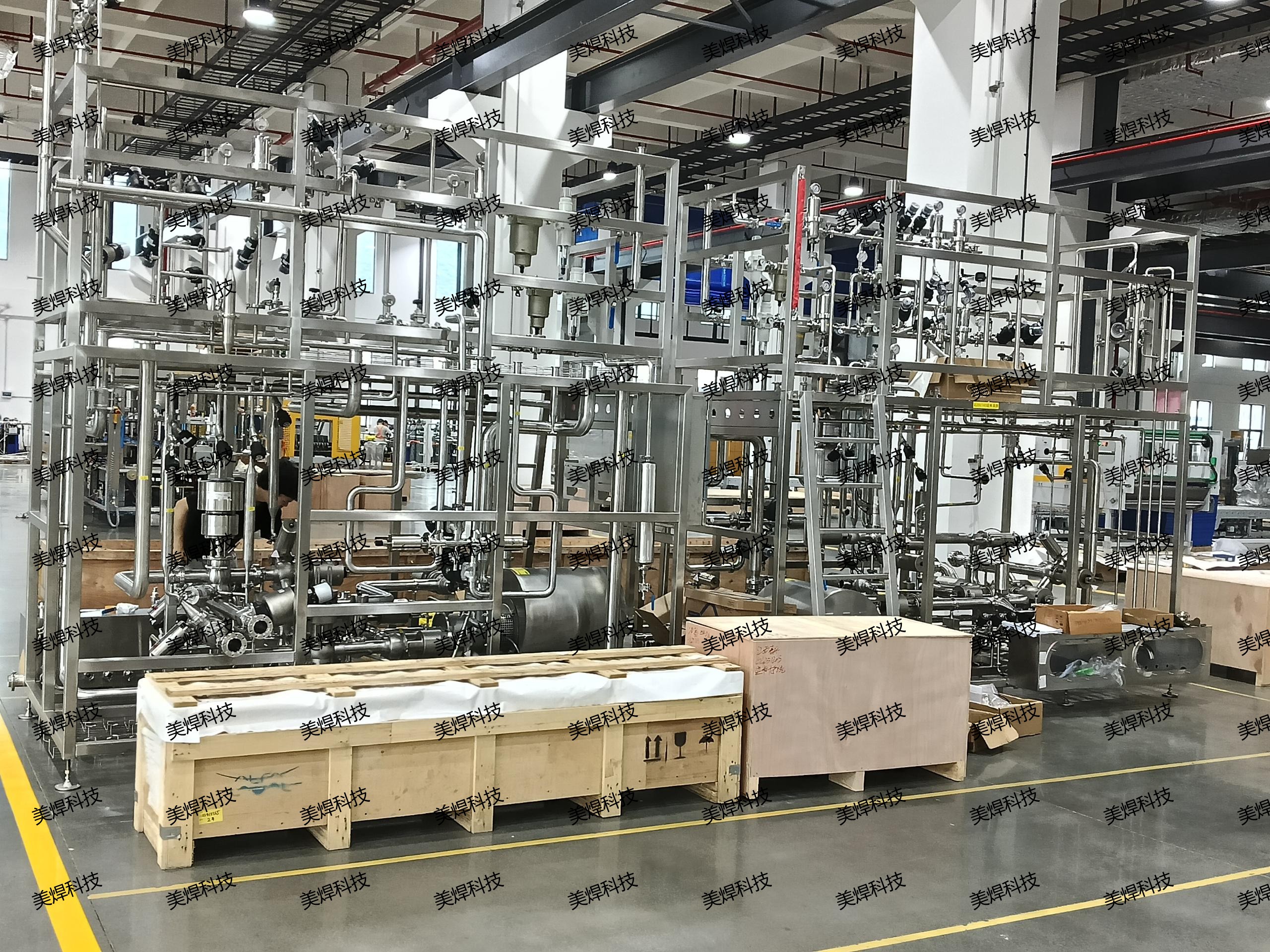
Mwelding completed equipment delivery, procedure qualification and initial production validation for this sanitary piping automatic welding project in partnership with Guangzhou XX Packaging Machinery Co., Ltd. in 2026. The project adopts the MWF Series Closed Orbital Tube Welding Machine as the primary unit, covering prefabrication welding of sanitary stainless steel piping for full-line equipment for beverage, dairy, seasoning, personal care and bottled water applications.
Item | Details |
Case Name | Automatic Welding Project for Sanitary Stainless Steel Piping – Guangzhou XX Packaging Machinery |
Industry | Liquid Food Packaging Machinery (full-line equipment for beverage, dairy, seasonings, personal care and bottled water) |
Product Model Deployed | Mwelding MWF Series Closed Orbital Tube Welding Machine; paired with MWG Series Open Orbital Tube Welding Machine |
Customer Type | End Equipment Manufacturer (supplier of full-line liquid processing equipment) |
Project Location | Guangzhou Economic & Technological Development Zone, Guangdong Province, China |
Delivery Date | 2026 (subject to project acceptance records) |
Base Material & Applicable Standards | 304 / 316L sanitary stainless steel, DN15 to DN100 (OD 19 mm to 108 mm), wall thickness 1.2–2.0 mm, inner surface Ra ≤ 0.8 μm; welding procedures follow ASME BPE, 3‑A, EHEDG and relevant Chinese sanitary piping specifications. |
Project Type | Automation upgrade & procedure qualification for sanitary piping prefabrication workshop |
1. Project Background & Customer Pain Points
Founded in 1998 in Guangzhou Economic & Technological Development Zone, Guangzhou XX Packaging Machinery Co., Ltd. is a liquid packaging equipment supplier. Its portfolio covers water treatment, beverage pre‑processing, PET blow molding, filling, bottled water, blow‑fill‑cap, blow‑label‑fill‑cap, labeling, conveying and secondary packaging full‑line systems, plus top‑level planning for smart workshops and smart factories. Its equipment serves end markets including still water, carbonated drinks, fruit juice, tea beverages, seasonings, personal care, dairy, grain & oil and bottled water.
Sanitary piping forms the core conveying network for these lines. From water treatment and pre‑processing to filling valve manifolds and CIP circuits, internal cleanliness, weld profile and sealing performance directly affect microbial control and line uptime. These pipes are mainly 304 / 316L stainless steel, with wall thickness of 1.2–2.0 mm and internal surface Ra ≤ 0.8 μm. Welds must be free of heat tint, weld bead reinforcement, lack of fusion and internal concavity.
Before the upgrade, pipe prefabrication relied on manual GTAW (TIG welding). Each joint took 12–15 minutes on average, including fit‑up, purging, welding and inspection. Initial borescope acceptance rate was approximately 85%. Common defects included excessive internal heat tint, localized lack of fusion and inconsistent reinforcement. Around 12% of joints required post‑weld pickling and passivation. Weld quality was highly dependent on certified welders, with only six skilled welders available. Production capacity was constrained when welders took leave or left the team. No automatic logging of welding parameters was available, making it difficult to provide joint‑by‑joint process records for factory audits and line acceptance.
The customer defined three core requirements: stabilize first‑pass acceptance rate, reduce joint cycle time to match line delivery schedules, and enable traceable welding process data.
2. Equipment Selection & Evaluation
The customer evaluated equipment across four dimensions. First, process compatibility: the system needed to handle thin‑wall sanitary tubing from OD19 mm to OD108 mm, wall thickness 1.2–2.0 mm, with no internal heat tint. Second, verifiable quality: welds must consistently pass borescope and pressure testing, with parameter logging and export capability. Third, changeover efficiency: beverage, dairy and seasoning projects involve frequent diameter changes, so changeover time must be controllable. Fourth, delivery and support: lead time, process commissioning support, operator training and spare parts response.
During benchmarking, the customer reviewed both imported orbital welders and domestic automatic tube welding systems. Imported brands have long‑standing experience in ultra‑thin wall and exotic alloy applications, yet they carry higher capital and weld head costs, longer lead times, and cross‑regional delays for process support and spare parts. Domestic systems deliver acceptable weld quality for standard sanitary diameter ranges, with faster local service response.
Mwelding MWF Series Closed Orbital Tube Welding Machine was selected as the primary unit, with the MWG Open Orbital Tube Welding Machine deployed for retrofits and confined‑space joints. Three key reasons drove the selection: the closed weld head chamber provides argon shielding to effectively suppress internal heat tint; the unit features built‑in parameter storage and export for audit documentation; modular weld heads enable size changeover without full machine rework.
3. Implementation Plan & Execution Details
The setup includes MWF closed orbital welder power supply plus multi‑size weld heads for OD19–108 mm; MWG open orbital welder for field repair and pre‑installed tube joint remediation; supporting tube purging assemblies, argon flow meters and gas purity monitoring; welding parameter management software for joint ID tagging, record keeping and report export.
Process parameters: base material 304 / 316L, OD 19–108 mm, wall thickness 1.2–2.0 mm. Square‑groove autogenous weld is standard; filler wire is used for thicker sections. Shielding gas is 99.999% minimum purity argon. Pre‑purge establishes low oxygen levels inside the tube before arc start. Welding is performed as enclosed chamber full‑position GTAW, achieving single‑sided welding with double‑sided formation.
Implementation followed six sequential steps.
Step 1: Welding Procedure Qualification. Test coupons were grouped by nominal diameter and wall thickness. Each group underwent borescope inspection, cross‑section evaluation and pressure testing to lock in current, travel speed, pulse profile and purge duration.
Step 2: Parameter Lock‑in. Qualified procedures were saved into the machine recipe library, with unique IDs indexed by diameter and wall thickness.
Step 3: Tooling & Fit‑up. Matching clamps were configured, with defined tolerances for root gap and misalignment.
Step 4: Operator Training. Two operators completed 3 days of training covering fixturing, recipe selection, post‑weld inspection and routine maintenance.
Step 5: Pilot Production Validation. Small‑batch production runs using real customer orders were sampled for borescope and pressure testing.
Step 6: Documentation Archiving. Every weld joint was tagged with project ID and operator ID, and parameter records were archived per production batch.
Three critical process notes: heat input control takes priority over travel speed for thin walls to prevent burn‑through and internal concavity; tube purging must complete before arc initiation — post‑arc supplemental purging cannot remove heat tint already formed; fit‑up gap and misalignment strongly affect autogenous weld profile, so clamping accuracy must be fixed in the procedure document.
4. Project Outcomes & Quantitative Data
Table 2 Comparison of Key Metrics: Pre‑Upgrade vs Post‑Upgrade
Metric | Before Upgrade (Manual GTAW) | After Upgrade (Mwelding Orbital Welding) |
Average joint cycle time | 12–15 minutes | 4–6 minutes |
First‑pass borescope acceptance rate | ~85% | ≥98% |
Joints requiring pickling & passivation | ~12% | <3% |
Operator qualification requirement | Certified skilled welder | General operator, 3‑day training |
Welding parameter logging | No records | Joint‑by‑joint logging, exportable archive |
Same‑size batch changeover | Manual adjustment required | Recipe library recall, minute‑scale changeover |
Note: Data above reflects on‑site statistics for pilot and initial production batches, excluding rework joints. Results may vary with tube diameter, wall thickness and site conditions.
5. Application Summary & Scope Boundaries
This project validates the practical feasibility of closed‑chamber orbital welding for sanitary piping prefabrication in liquid food processing equipment. For standard sanitary tubing OD19–108 mm, wall thickness 1.2–2.0 mm, automated welding delivers tangible value in weld consistency, internal surface quality and data traceability.
Relevant applications include prefabrication of beverage and dairy line piping, water treatment and CIP circuit piping, seasoning & personal care fluid piping, and bottled water filling line piping. Ultra‑thin wall tubing below 1 mm, exotic alloys or non‑standard complex fittings require separate procedure qualification before orbital welding can be adopted.
6. Frequently Asked Questions
Q1: What level of internal heat tint can be controlled with orbital welding on sanitary stainless steel tubing?
A1: With proper tube purging and argon purity ≥99.999%, closed‑chamber orbital welds can achieve silver or straw‑colored internal surfaces, satisfying Ra ≤0.8 μm and borescope inspection requirements. Heat tint performance depends on purge duration, gas purity and heat input, and must be confirmed by procedure qualification.
Q2: Is 1.2 mm thin‑wall sanitary tubing more prone to burn‑through with orbital welding?
A2: Thin‑wall welding is governed by heat input control rather than travel speed. Mwelding MWF units run pre‑qualified recipes indexed by diameter and wall thickness, matching pulse profile and travel speed to control penetration. No systematic burn‑through occurred during mass production for the 1.2 mm wall sections in this project after procedure qualification.
Q3: Does orbital welding require longer changeover time than manual welding for frequent product switches?
A3: Same‑size batch changeover involves fixture swap and recipe recall, completed in minutes. Cross‑diameter changeover requires weld head replacement; timing depends on the number of weld head sizes. We recommend stocking weld heads for your most frequent diameters to reduce downtime.
Q4: Can welding records be used for customer factory audits and line acceptance?
A4: The system supports joint ID tagging, parameter logging and report export, which can be archived per project or batch as audit documentation. Final deliverable formats should be confirmed in advance against customer and end‑user acceptance specifications.
Q5: Can orbital welding fully replace certified welders?
A5: It cannot fully replace welders. The machine executes repetitive welding cycles, while procedure qualification, defect judgment, rework and complex confined‑space joints still require certified personnel. The practical benefit is reduced reliance on high‑skill welders for daily production, rather than eliminating welding roles.
Disclaimer: All data presented reflects on‑site test results from this specific project. Final performance is subject to tube material quality, argon purity, site conditions and operator compliance. Equivalent results are not guaranteed for all applications. We recommend coupon testing before selecting orbital welding equipment for your piping project.
If you require coupon welding trials or technical evaluation for sanitary stainless steel piping projects, contact Mwelding for technical support.